
Shipbuilding & Offshore Platforms
Seawater is the most aggressive natural electrolyte: roughly 19,000 ppm chlorides, plus wet-dry cycles and crevice gaps. Here the first criterion is not strength, but the material's ability to resist crevice corrosion.
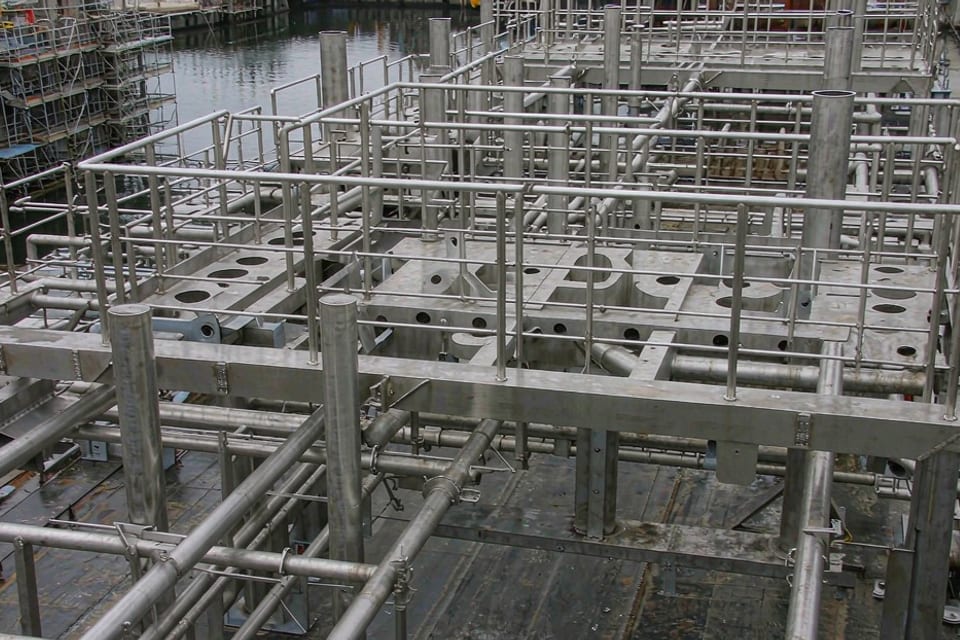
Typical Components & Material Selection
| Component | Grade | Surface / Size | What to Watch For |
|---|---|---|---|
| Deck railings / rigging | 316L | Tube / profile, polished | Salt spray, post-weld passivation |
| Seawater piping | 2205 / 6Mo | Seamless / welded tube | Pitting, flow erosion wear |
| LNG tank inner shell | 304L / 304 | Plate 8–50 mm | Low-temperature impact toughness, class approval |
| Accommodation / galley equipment | 304 / 316L | 0.8–2 mm, 2B/HL | Cleanability, fingerprint resistance |
| Fasteners / fixtures | 316 / 2205 | Bar / forging | Stress corrosion cracking |
Three real constraints in this industry
Crevice corrosion is the dominant failure mode
Under gaskets and where brackets contact the hull, 304 shows rust within a few months. Eliminate the crevice by design (continuous welds, drain holes) and switch to 316L or 2205.
Confirm class society approval in advance
DNV / ABS / LR / CCS maintain their own approved material lists. A higher-grade material without approval still fails inspection — verify at the quotation stage.
Welding distortion accumulates toward assembly
Thin rigging components distort, and tolerance errors stack up at final assembly. Fabricate in sections with anti-distortion jigs and leave allowance for trim-off.
Related Products
Need a quotation or technical support?
Send us the component, grade, size, quantity and destination port — we will reply with FOB / CIF within 24 hours.